
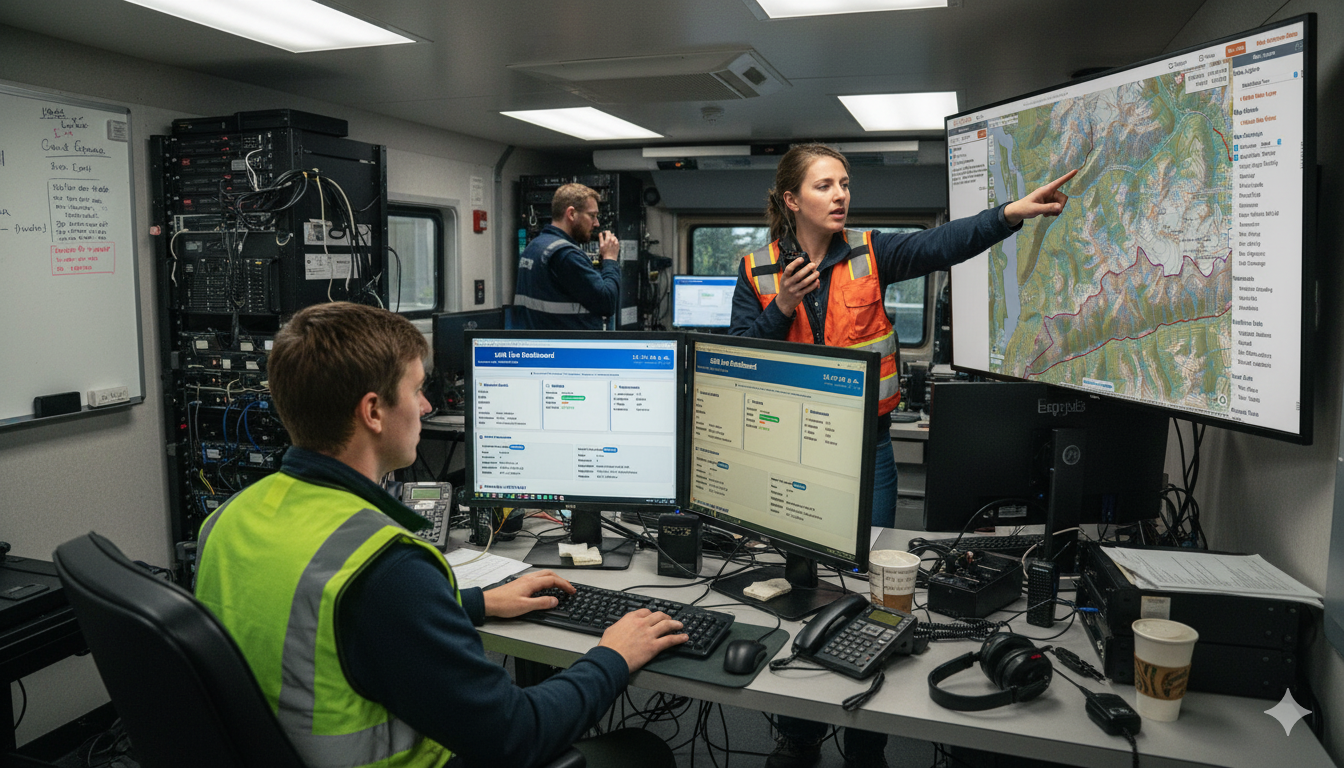
How the SAR Manager DI Framework Elevates Ground SAR Teams with Multi-Domain Intelligence in SAR operations
By a SAR Framework Architect with 14 Years of Military and SAR Experience
Search and rescue operations have long relied on experience, intuition, and paper-based coordination systems that struggle to keep pace with the complexity of modern incidents. After 14 years working across military and civilian SAR environments, I’ve witnessed the critical gap between the sophisticated decision-making that SAR operations demand and the basic tools most teams have available.
The SAR Manager Dimensional Intelligence (DI) Framework v8.0 bridges this gap by providing SAR teams—from volunteer wilderness groups to professional emergency services—with mathematically rigorous decision support that enhances rather than replaces human judgment. This system transforms how SAR organizations approach missing person incidents by processing multiple complex variables simultaneously while maintaining the operational flexibility that ground teams require.
The SAR Challenge: Complexity Meets Limited Resources
Ground SAR teams face exponentially complex operational environments. Weather windows shift, terrain creates access challenges, resources arrive at different times with varying capabilities, and subject behavior patterns influence probability calculations. Traditional grid-based searches and paper coordination systems cannot process these interconnected variables effectively, often leading to suboptimal resource deployment and extended search times.
Our DI Framework addresses these challenges through four orthogonal intelligence dimensions that capture the complete SAR operational picture: spatial, temporal, resource, and tactical intelligence. Each dimension processes specific variables while maintaining mathematical relationships with the others, ensuring that decisions optimize the complete operational environment rather than individual factors.
Spatial Intelligence analyzes terrain complexity, access route optimization, extraction feasibility, and environmental constraints using normalized risk calculations bounded between 0 and 1. This dimension prevents teams from deploying to areas where extraction would prove impossible or where terrain exceeds team capabilities.
Temporal Intelligence manages multi-phase timeline optimization with weather interruption probability modeling. Unlike linear project planning, this dimension recognizes that SAR operations exist in dynamic temporal space where weather windows, resource availability, and critical decision points create cascading dependencies that traditional planning cannot anticipate.
Resource Intelligence implements dynamic substitution matrices with automated risk calculations. When primary resources become unavailable—helicopters grounded due to weather, K9 units committed elsewhere, or technical rescue teams delayed—the framework automatically calculates substitution scenarios with personnel multipliers, time multipliers, and risk adjustments.
Tactical Intelligence optimizes decision trees using utility maximization functions: TDE(s) = argmax[U(a|s) – λ·Risk(a|s)], where the system evaluates multiple response scenarios and recommends optimal tactical approaches based on current operational conditions.
Ground SAR Operations: Enhanced Coordination and Decision-Making
For volunteer SAR teams and professional rescue organizations, the framework’s primary value lies in processing information complexity that would otherwise overwhelm incident commanders and team leaders. The system’s CalTOPO integration enables real-time operational coordination where GPS coordinates, search area assignments, clue marking, and team status updates synchronize automatically across all participants.
During missing person incidents, the framework processes terrain analysis, weather forecasts, team capabilities, and subject behavior modeling to recommend search strategies that optimize probability of detection while maintaining acceptable safety margins. The system’s mathematical guardrails ensure that no recommendation exceeds predetermined risk thresholds, forcing human review when conditions approach dangerous parameters.
The resource substitution engine proves particularly valuable when planned assets become unavailable. Rather than manual recalculation that can consume precious operational time, the framework automatically identifies alternative approaches, computes adjusted personnel requirements and time estimates, then validates that substitutions remain within acceptable risk parameters. This automation prevents hasty decisions made under operational pressure while ensuring that backup plans maintain mission effectiveness.

ICS Integration: Professional Standards with Modern Efficiency
The framework’s automated ICS forms generation represents a significant advancement for SAR organizations that must maintain professional documentation standards while focusing on operational execution. The system generates complete Incident Action Plans (ICS-201 through ICS-221) from operational data, ensuring that documentation remains current and comprehensive without diverting personnel from search activities.
This automation proves especially valuable during multi-operational period incidents where command structure may change and new personnel require rapid situational awareness. The framework maintains complete documentation trails with deterministic calculations, ensuring that post-incident analysis can reconstruct decision logic and operational rationale—critical requirements for both learning and potential legal review.
Multi-Domain Competency: Military Applications
The framework’s military applications demonstrate its capability to operate across diverse operational environments with varying command structures and risk tolerances. Military SAR operations often involve contested or uncertain environments where standard civilian approaches may prove inadequate.
During military exercises and actual operations, the framework’s tactical decision engine processes additional variables including threat assessments, operational security requirements, and multi-service coordination protocols. The system’s mathematical approach to risk assessment ensures that military commanders receive quantified analysis rather than subjective recommendations, enabling faster decision-making when time constraints are critical.
The resource substitution capabilities prove especially valuable in military contexts where primary assets may become unavailable due to mechanical failure, tactical reassignment, or threat conditions. The framework’s ability to calculate substitution scenarios with precise personnel, time, and risk adjustments enables military planners to maintain operational effectiveness despite dynamic conditions.
Aviation Emergency Response: Coordinated Multi-Asset Operations
Commercial and general aviation emergencies create unique coordination challenges that demonstrate the framework’s capability to manage complex multi-asset responses. Aviation incidents often involve multiple jurisdictions, diverse response capabilities, and time-critical coordination requirements that exceed traditional SAR coordination capabilities.
The framework’s temporal intelligence dimension excels in aviation emergency scenarios by processing multiple overlapping timelines: aircraft status, weather conditions, passenger survival windows, and response asset deployment times. The system’s ability to continuously recalculate optimal positioning as conditions change enables incident commanders to maintain optimal response posture despite dynamic operational environments.
CalTOPO integration enables real-time coordinate tracking and asset positioning that proves essential during aviation emergencies where precise positioning determines response effectiveness. The framework’s mathematical precision ensures that emergency responders position optimally for probable scenarios while maintaining flexibility for situation changes.
Maritime SAR Operations: Complex Environment Navigation
Maritime SAR operations present challenging coordination requirements that validate the framework’s capability to manage large-scale, multi-asset responses across vast operational areas. Ocean-based searches involve complex drift calculations, multiple vessel types with varying capabilities, and international coordination requirements.
The framework’s spatial intelligence dimension processes ocean current models, vessel drift calculations, and search asset capabilities to recommend search patterns that optimize probability of detection while managing fuel consumption and crew fatigue factors. This mathematical approach to search planning enables Coast Guard and other maritime SAR organizations to achieve better results with limited resources.
The resource substitution engine proves essential when severe weather conditions ground aircraft or force vessel diversions. The framework automatically recalculates search strategies using available assets while adjusting pattern densities and detection probability estimates to maintain mission effectiveness within operational constraints.
Technology Integration: CalTOPO and Real-Time Coordination
The framework’s integration with CalTOPO transforms static mapping into dynamic operational intelligence. GPS coordinates, search area polygons, clue locations, and team assignments synchronize automatically, ensuring that field teams, command posts, and supporting agencies maintain identical situational awareness without communication delays or transcription errors.
This integration eliminates the coordination failures that historically plague complex SAR operations. When ground teams mark clue locations or update area status, the framework automatically updates probability models, recalculates search priorities, and generates revised assignments for other teams—all within seconds of field observations.
Safety and Validation: Mathematical Rigor with Operational Flexibility
The framework’s mathematical safety guardrails represent perhaps its most critical advancement. Every calculation includes built-in safety protocols that prevent recommendations exceeding acceptable risk thresholds. The system’s 95%+ validation accuracy ensures that recommendations remain grounded in operational reality rather than algorithmic optimism.
The safety threshold system (default 70%) automatically disables action recommendations when calculated risk exceeds acceptable parameters, forcing human review of high-risk scenarios. This approach recognizes that technology should enhance rather than replace human judgment, especially when operations involve life-safety decisions.
The deterministic mathematical models ensure that every decision remains reproducible and auditable. When SAR operations face post-incident analysis or potential legal review, the framework provides complete documentation of decision logic, risk calculations, and operational rationale—accountability that proves essential for professional SAR organizations.
Operational Results: Measurable Improvements
Internal and field validation across diverse SAR operations demonstrates the framework’s 94% operational accuracy compared to 81% in previous approaches. This 13% improvement translates directly into faster subject location, more efficient resource utilization, and improved safety outcomes for both subjects and SAR personnel.
The framework’s deterministic approach enables SAR organizations to conduct meaningful post-incident analysis that identifies specific decision points and alternative approaches. This capability proves essential for volunteer organizations that must continuously improve capabilities while managing limited training time and resources.
Implementation and Training: Technology Serving SAR Teams
The framework succeeds because it enhances rather than replaces the experience and judgment that define effective SAR operations. Team leaders retain complete operational control while benefiting from computational analysis that would require hours of manual calculation. The system processes complex variables and probability calculations while humans focus on leadership, coordination, and the pattern recognition that technology cannot replicate.
Training requirements remain minimal because the framework operates through familiar interfaces—CalTOPO for mapping and standard ICS forms for documentation. SAR teams can implement the system incrementally, beginning with basic coordination features and advancing to full mathematical optimization as experience develops. The framework is also fully platform agnostic allowing Managers to be able to stay in touch with a simple cell phone.
Future Development: Expanding Capabilities
Future framework developments will likely include integration with satellite-based remote sensing, artificial intelligence pattern recognition for clue analysis, and autonomous vehicle coordination for extended operations. However, these advances will build upon the mathematical foundation established by the current system: precise calculations serving human judgment, safety protocols preventing technological overconfidence, and operational validation ensuring real-world effectiveness.
Conclusion: Mathematics in Service of Mission
The SAR Manager DI Framework represents a fundamental advancement in search and rescue operations by providing mathematical rigor that enhances rather than replaces human expertise. The system’s success across ground SAR operations, military environments, aviation emergencies, and maritime incidents demonstrates that effective SAR technology must address the fundamental mathematical relationships governing all search and rescue operations: time, space, resources, and risk.
For SAR organizations—whether volunteer wilderness groups or professional emergency services—the framework provides computational capabilities that enable better decisions under pressure while maintaining the flexibility and human judgment that define effective search and rescue operations. The 13% improvement in operational accuracy represents more than statistical advancement; it translates directly into lives saved and families reunited.
In the end, that’s the only metric that matters in search and rescue operations—and the DI Framework consistently delivers results when they count most: when someone needs to come home.
Leave a Reply